Whether you’ve just purchased an EV or you’re planning to buy one soon, this guide will walk you through everything you need to know to make home charging easy, efficient, and cost-effective.
Charging your EV at home is the most convenient and affordable way to keep your vehicle powered.
Save money on gas and avoid public charging station fees
Recharge overnight while you sleep for daily convenience
Protect battery health with smart charging practices
Boost home value by adding a dedicated EV charging port
Cost Savings of Charging at Home
Lower "Fuel" Costs
Electricity is substantially cheaper than gasoline. In Ontario, charging an EV costs up to 75% less than fuelling a gas-powered car for the same distance. On average, it costs under $2 per 100 km when charged at home using off-peak electricity rates, compared to $8–$12 per 100 km for gasoline-powered vehicles.
Example: Charging a 60 kWh EV battery (400 km range) typically costs $6–$9 at home, while driving the same distance in a traditional vehicle could cost $50–$70 depending on gas prices.
Time-of-Use Electricity Rates
Ontario uses a Time-of-Use (TOU) electricity billing structure, which means rates vary based on when electricity is used.
Off-peak hours (11 PM – 7 AM) have the lowest electricity rates—ideal for overnight charging.
Mid-peak and on-peak hours (during daytime and early evenings) are more expensive.
By using a smart charger that schedules your charging sessions during off-peak periods, you can dramatically reduce your electricity costs without lifting a finger.
Government Incentives & Rebates
Eligible homeowners can take advantage of federal, provincial, and local rebates to offset installation and equipment costs. For example:
Federal Incentives under the Zero-Emission Vehicle Infrastructure Program (ZEVIP) may offer rebates for multi-unit residential buildings.
Some utility providers and municipal programs offer additional rebates, such as partial refunds on Level 2 chargers and installation fees.
In some cases, tax incentives may apply for installing EV infrastructure in homes or rental properties.
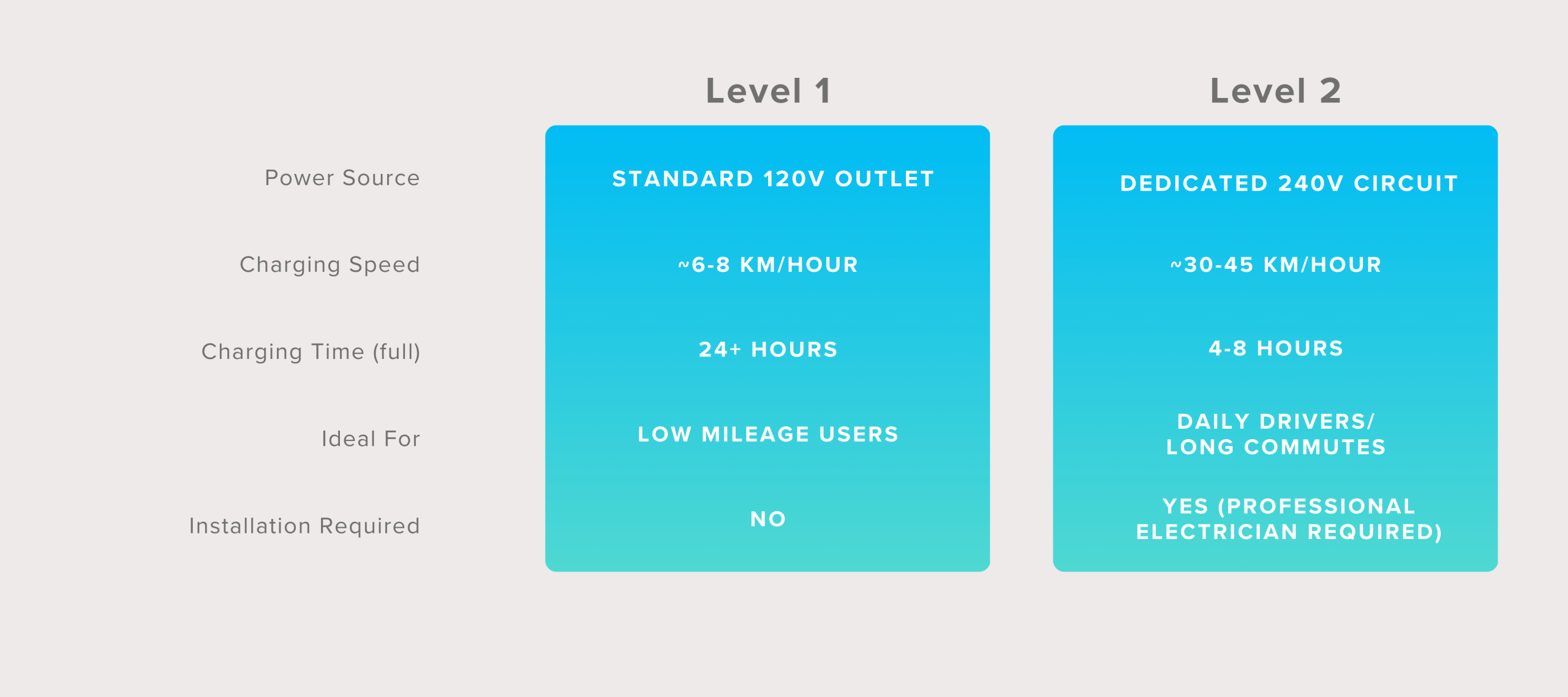
Level 1 vs. Level 2 Home Charging
Below is a side-by-side comparison to help you see how these two charging levels stack up in terms of speed, setup, and suitability for your daily needs.
Top Home Charging Tips
Use a Smart Charger: Automate charging and track your usage.
Keep It Indoors or Weather-Proof: Use indoor garages or weather-rated chargers for outdoor setups.
Charge to 80–90%: Prolong battery life by avoiding frequent 100% charges.
Avoid Extreme Temperatures: Charging in very hot or cold conditions may reduce battery efficiency.
Regularly Inspect Equipment: Look for wear, damage, or loose cables.
WHAT OUR CUSTOMERS ARE SAYING
Client Tesimonials
William Ferguson
Evolta did all of the electrical work for by basement reno, as well as some additional work I needed done in other areas of my house. They showed up on time, were very professional, clean, answered all my questions promptly and did great work! I'll definitely be calling them back for any future electrical work I need done.
Scott Shurtliff
“I first became aware of Evolta while attending a recent home show. Gave an excellent first impression and were very helpful to answer any and all questions I had. Everyone was excellent and very professional to deal with throughout every step of the way in regards to an EV charger installation I needed done. I would highly recommend them and have already done so to others.”
Alphonse Rivers
I used Evolta for an EV charger installation at my office - a Wallbox charger. They were helpful, professional, and the job looks good. I am looking forward to using them again.
Paul Tweedale
Professional, courteous service clearly explaining work needed and carried out by a Master electrician and assistant.
Ready to move forward with one of our electrical services? Whether it’s for your electric vehicle station or your property, we’re always happy to help. Get in touch with us to get started.
Get in touch with
Our partners
Our partners share the same passion for smart energy, one way or another.